2026
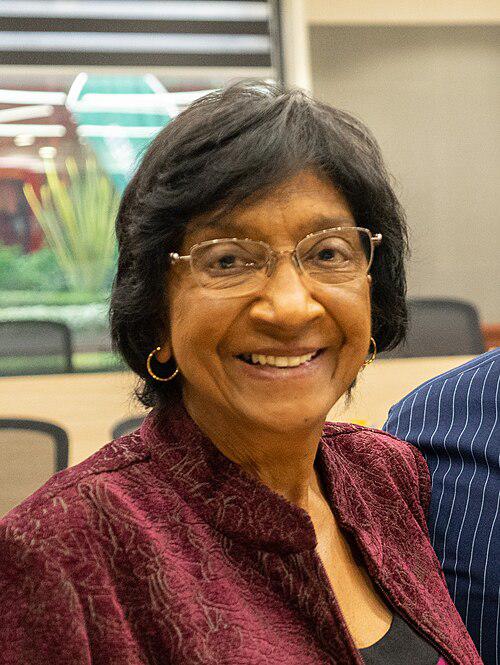
NAVANETHEM “NAVI” PILLAY (1941–)
South Africa
“Navi Pillay is one of the great defenders of international legal principles in our time. Her distinguished career reminds us of the need to support, fortify, and expand the global rule of law.”
Announcement from the Norwegian Nobel Committee, October 9, 2026.
The 2026 Nobel Peace Prize, awarded to South African judge Navi Pillay was surprisingly courageous and provocative. In the context of Nobel history, it is of the same caliber as the prizes awarded to Nazi opponent Carl von Ossietzky and democracy advocate Liu Xiaobo from China.
But first, some words about international law.
The struggle for international law is a cornerstone of the history of the Nobel Peace Prize. By awarding the first prize in 1901 to Henry Dunant—founder of the Red Cross—and subsequently honoring the organization itself on three occasions, the Nobel Committee has been a steadfast defender of the Geneva Conventions. These intergovernmental treaties form a central part of the international law of armed conflict, also known as international humanitarian law. They are designed to protect sick and wounded soldiers, prisoners of war, and civilians during wartime.
In the years leading up to the First World War, the Nobel Committee valued the international peace movement’s efforts to resolve conflicts between states through an international court and arbitration. Several laureates were recognized for promoting these objectives and for driving the construction of the Peace Palace in The Hague, Netherlands. Since 1913 the Hague has housed the world’s most significant international legal tribunals.
Following 1945, the United Nations became the Nobel Committee’s primary instrument for safeguarding the rights of individuals and vulnerable groups. The prizes awarded to the Office of the United Nations High Commissioner for Refugees (UNHCR) drew global attention to the refugee conventions and fostered a greater understanding of people forced to flee their homes. From the 1960s onwards, defending the 1948 UN Universal Declaration of Human Rights became a central priority for the Nobel Committee. UNICEF laid the groundwork for the 1989 UN Convention on the Rights of the Child, while the International Labour Organization (ILO) worked to secure the rights of workers. Iranian women Shirin Ebadi and Narges Mohammadi championed the core principles of the 1979 UN Convention on the Elimination of All Forms of Discrimination against Women, and the Indian activist Kailash Satyarthi brought renewed focus to the provisions of the 1999 ILO Convention concerning the Prohibition and Immediate Action for the Elimination of the Worst Forms of Child Labour.
Both the International Court of Justice and the International Criminal Court had long been nominated for "the world’s most prestigious award." Yet a female judge who had served on both courts—and who fully met the criteria for the prize—was not among the favorites in the autumn of 2026.
Navi Pillay was born in 1941 in the South African city of Durban, into a family of Indian descent. She pursued a career in law and early on became a role model for those fighting against the racist apartheid regime. Pillay served as a defense lawyer for liberation leader Nelson Mandela and became the first person of color to be appointed as a High Court judge, before going on to make an impressive contribution to the development of a global legal order.
As a judge at the International Criminal Tribunal for Rwanda, Pillay was a driving force in defining sexual violence and rape as acts of genocide. From 2003 to 2008, she served as a judge at the International Criminal Court (ICC), and from 2008, she held the position of UN High Commissioner for Human Rights. In that role, she condemned abuses against civilian populations during the Arab Spring and championed the rights of sexual minorities (LGBT) — efforts that laid the groundwork for the "Free & Equal" campaign. She also issued warnings against unchecked state-sponsored digital surveillance.
When Pillay received the peace prize, she was serving as a judge at the International Court of Justice (ICJ), where Myanmar stands accused of genocide against the Rohingya minority. However, the gravity of this case was overshadowed by the Nobel Committee’s tribute to Pillay for holding states and heads of state accountable for violations of international law and the international courts. The announcement did not explicitly name those to whom it referred, but neither Pillay nor others were in any doubt that the statement concerned the heads of state of Israel, the United States, and Russia: Prime Minister Benjamin Netanyahu, President Donald Trump, and President Vladimir Putin.
Pillay’s efforts to combat violations of international law took on symbolic weight, as she received the news of the peace prize while at the site of the Nuremberg trials—proceedings that, following the Second World War, handed down severe sentences to several leading Nazis for war crimes. The newly named laureate herself believed that her leadership of the UN Independent International Commission of Inquiry on the Occupied Palestinian Territory, including East Jerusalem, was a key reason she was awarded the prize, stating: "The last thing I did was submit the report on Gaza, which concludes that what is happening there is a genocide."
From Nuremberg, Pillay dedicated the peace prize to "all survivors of international crimes, and to those who work for and defend international justice—people whose compassion and courage ensure that impunity does not prevail."
International reactions to the 2026 prize were, for the most part, highly positive; however, Israel reacted with revulsion. Prime Minister Netanyahu—who, in the autumn of 2024, had been accused by the ICC of war crimes, resulting in an arrest warrant—described the laureate as “a bigot who built her career around inventing and propagating blood libels against the one and only Jewish state.” The Israeli Ministry of Foreign Affairs stated that the Nobel Committee had “rewarded the biggest lie of the 21st century,” adding that “Joseph Goebbels is certainly applauding from hell.”
The Trump administration aligned itself with the Israeli criticism and expanded sanctions against the ICC, imposing travel restrictions and financial penalties on the judges. American frustration toward Pillay reached a peak when President Trump attacked the Nobel Committee for rewarding someone he had never heard of, rather than giving the prize to him for having stopped eight wars. Consequently, he declared that “Norway sucks” and is a “shit house country.”
Negative remarks also emerged from Moscow—which, as early as 2023, had lashed out against the ICC’s arrest warrant for Putin regarding his responsibility for the illegal deportation of children from Ukrainian territory to Russia. According to former President Dmitry Medvedev, the warrant was not worth the paper it was written on and belonged in the toilet.
It will be interesting to hear Pillay’s Nobel lecture on December 10th of this year.